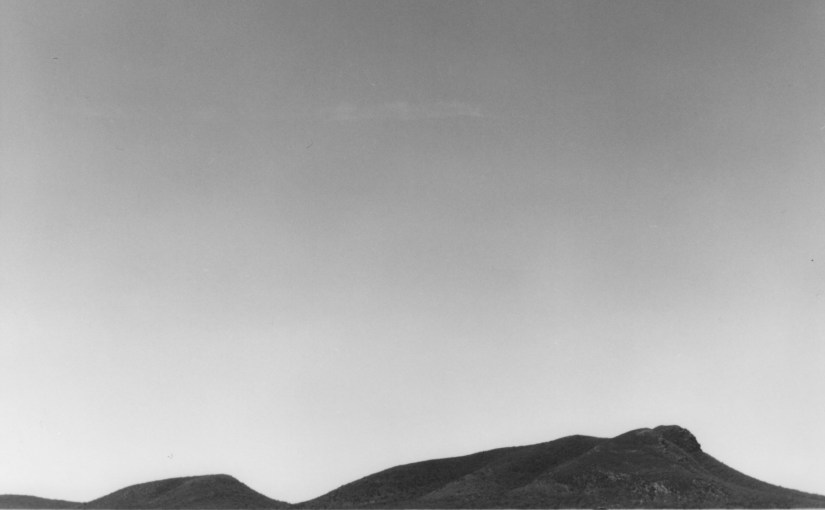
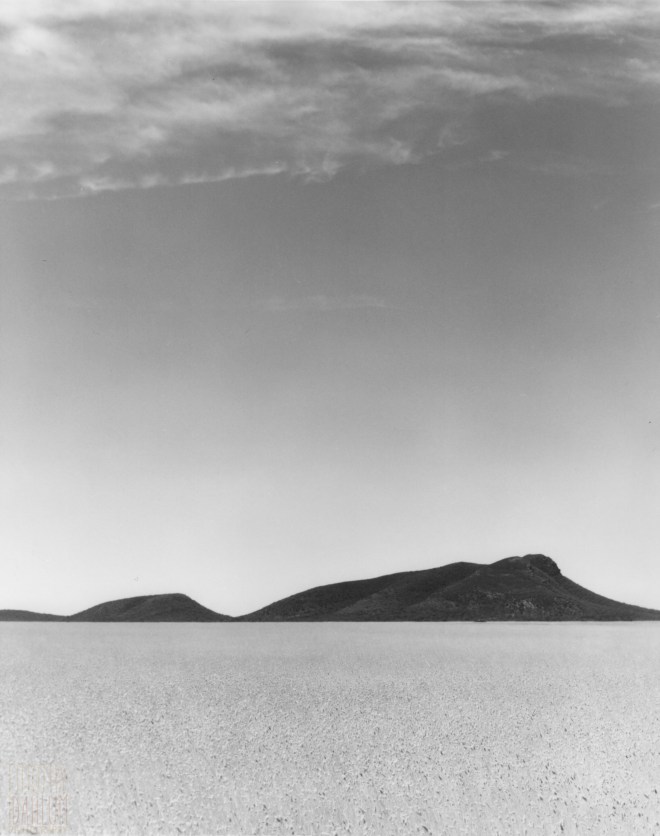
 This is the first print I’ve made from the first exposures I shot on the Intrepid 4×5 camera I received the day before we left for Australia earlier this year. It was a fun learning on the fly once I got to Australia and attempted to start putting everything I’d learned on other camera systems before I left. Each large format camera and lens combination has its own quirks and learning curve. The Intrepid is a light and sturdy field camera made in England and made of wood primarily, this allows for extreme portability and wanting to haul it up mountains or down cliff sides (unlike its studio camera cousins that weigh a ton and are large and bulky).
We were on our way to the Gariwerd (Grampians National Park) from the southern coast when we got our first glimpse, across fields of grain, of the southern ranges of the Gariwerd mountains. This location was so different from where we’d spent the previous couple of days along the coast, here it was still and hot, which was conducive to photography with a small box kite (I’d been unable to shoot along the coast because the winds were so intense that the camera would have vibrated or been torn apart). Here I only had to contend with the stiffing heat while I stood under a dark cloth sweating, steaming up my glasses, being nibbled on by the local insects, and occasionally attacked by large grasshoppers crawling up my jeans.
This field along a small road in the backcountry was a quiet spot to take the time necessary to set up, compose, and expose four sheets of 4×5 black and white film, each with different filtration (yellow, orange, red, and a circular polarizer) to get a balance of the sky, the mountains, and the grain field in the foreground. Making sure to shoot all four filtration approaches meant I would come away with at least one good photo, with the understanding that I may not have the chance to return to that spot again. When I began shooting filtration for the sky was necessary because there weren’t any clouds at all, over the course of an hour or so that I was there and preparing, the weather began to change as the afternoon drug on and a few wispy clouds appeared making the composition more interesting.
I ended up using my Canon F-1 35mm camera as my meter. This was the expedient route since I already knew how the meter worked with the Foma Ultra 100 film (at least in 35mm roll film form which is close enough), and that I could at least get predictable results when I got back several weeks later and developed them in the lab. I’ve now switched to a separate metering system and calibrated my sheet film separately from my 35mm process in order to get the best from the negatives on my current paper emulsion.
This is a scan of a print on 8×10 Ilford MGFB (silver gelatin) paper, shot on Foma 100 (Arista EDU) black and white 4×5 film, with an Intrepid 4×5 Camera and a 210mm f/6.8 lens.
 Timothy Dahlum